
Showing posts with label Wave. Show all posts
Showing posts with label Wave. Show all posts
Thursday, May 26, 2011


Friday, June 13, 2008
Schoolbook Physics meets Ancient Knowledge
As it was proven that every thing could be translated in to pure energy with Einstein's E=mc2 the world of science and the world of alternative beliefs was bridged. Long before today's common beliefs and religions were formed, there was a functioning world without explanations. Since then many men dedicated their lives to put words on how every thing is. The older traditions have one thing in common, they regard every thing as living, as a form of energy. The words that has been put on this view are many and different, but they all point in the same direction as E=mc2.
One way to picture energy is to see the image of a wave. It has movement, but doesn't move. This way of looking at it, is close to how schoolbooks explains for example: sound, electricity and light. To use sound as an illustrating example, it's not the sound that moves, but rather the air.
In the Theory part of this blog, we used the wave too illustrate a rhythm of changes. Changes in society, fashion, style, design and every other man made thing that changes over time.
If we can see this rhythm of changes as a wave it is easier to see trends. What is a trend? We can calculate a trend estimation based on patterns and curves when it comes to physics and math. When it comes to style and fashion trends, we can notice the changes and understand that some stuff is becoming more popular and other stuff is loosing its popularity. After a couple of years in the fashion business I started to understand that fashion trends are intimately related to other social and economical trends. After a couple of more years travelling the world and designing more clothes I also saw that our whole world is changing after the same particular pattern that I initially thought only considered fashion.
If we visualise social and fashion trends as a wave, what directs this wave?
If it is air pressure that makes sound waves. What kind of force makes social and fashion waves?
I started this blog with the purpose to make this force visible. As a guidance tool.
Friday, March 2, 2007
New Creativity

The lame post millennium waiting is over. The natural reaction now is to clean up and create. A creative wave is up and coming. We recognize some ingredients from the fifties. There is a tremor of change in the wind. Will we once again put wings on our cars? Will we once again create superheroes as modern archetypes? Look around you. The new time of super is here.
At last we found a way to use IT to be creative. The new way of doing is sharing. Do your absolute best, share without expectations and you will get something in return.
"Creativity, it has been said, consists largely of re-arranging what we know in order to find out what we do not know." George Kneller
"Creativity is allowing oneself to make mistakes. Art is knowing which ones to keep." Howard Aiken
"Some people see things and ask Why? I dream things which never were and ask Why not?"
Ketaki Bhave
"Most people are more comfortable with old problems than with new solutions."
Charles Brower
Monday, December 11, 2006
Letting go

This goes for personal as well as corporate evolution.
Acting without expectations of personal gain will be the way to creative success. Projects that comes from scheming for profit will due to old reason lack the necessary edge to attract the modern human.
Heartful and generous doings that generates its own momentum naturally attracts and surprises.
This is very visible in communication and advertising. The modern human can not be attracted with the same methods that has been used before. Notice how advertising finds new ways.
Letting go is about giving up control to gain growth and knowledge. Corporate leadership that clings to "the old model" based on distrust and control will not be able to stay competitive compared to the ones that embrace the new approach with trust and creativity.
Saturday, November 18, 2006
Theory

Looking at times with this limited reference makes it possible to get a rhythm.
A rhythm can be viewed as a wave or as a change of intensity:

Looking closer at the main rhythm will show minor beats and breaks along the way that gives smaller fluctuations to the main beat.
These smaller fluctuations are affected by the earlier main rhythms. Example: Bigger events in history are repeated in smaller ways at a later time.
A lot of different rhythms exists simultaneous overlapping each other.
If all different rhythms are viewed from enough distance we can see a major rhythm that is affecting everything.
A rhythm can be viewed as a wave or as a change of intensity:
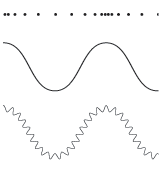
Looking closer at the main rhythm will show minor beats and breaks along the way that gives smaller fluctuations to the main beat.
These smaller fluctuations are affected by the earlier main rhythms. Example: Bigger events in history are repeated in smaller ways at a later time.
A lot of different rhythms exists simultaneous overlapping each other.
If all different rhythms are viewed from enough distance we can see a major rhythm that is affecting everything.
Subscribe to:
Posts (Atom)
